
Dec 1, 2025

be;yond the spectrum: A Night to Connect
How a thoughtfully designed social night opened the door to connection, confidence, and community for young adults on the autism spectrum.

How a thoughtfully designed social night opened the door to connection, confidence, and community for young adults on the autism spectrum.

How a thoughtfully designed social night opened the door to connection, confidence, and community for young adults on the autism spectrum.

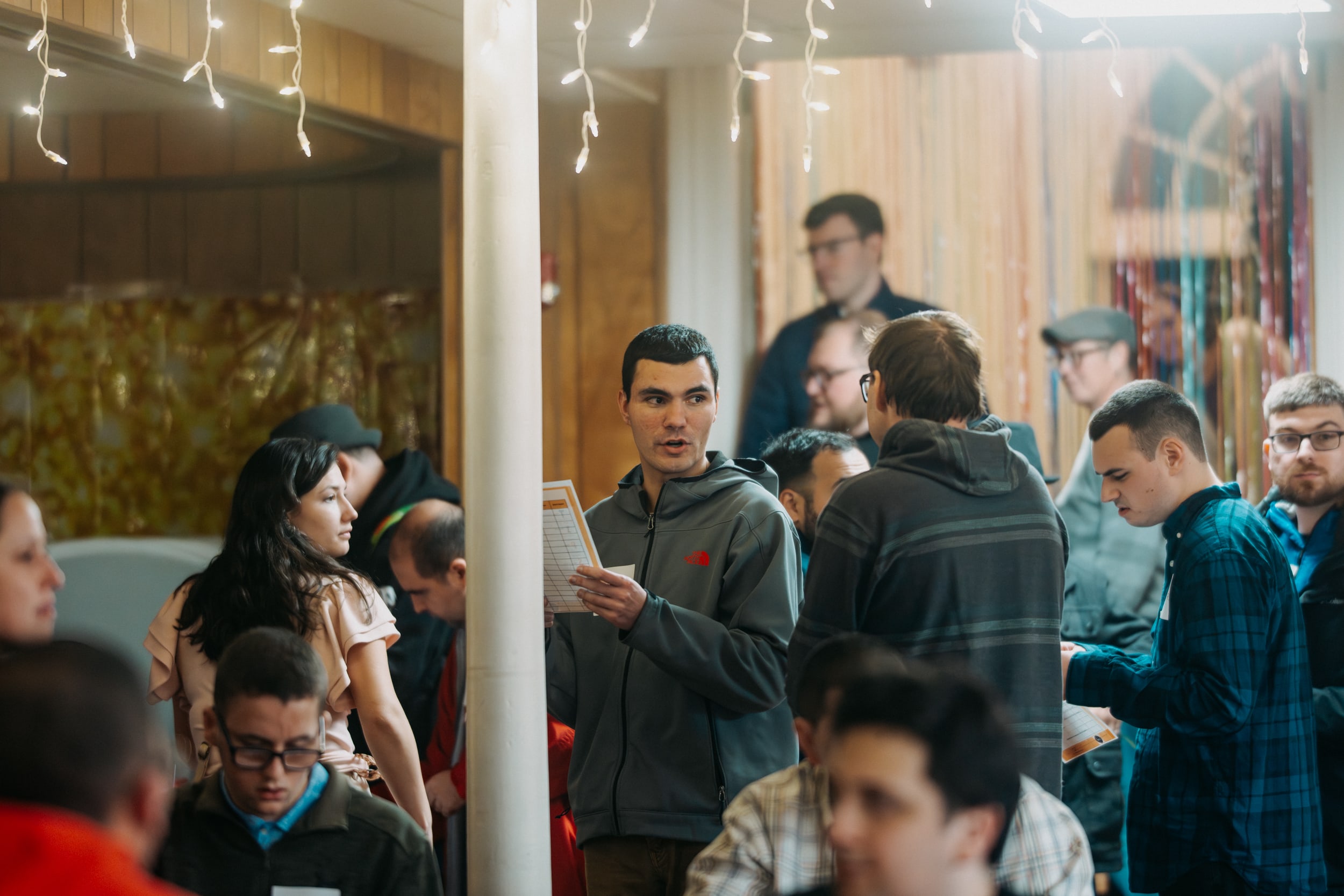
A candid photograph taken indoors at a social gathering. A young man in a gray North Face hoodie is prominently featured in the center, looking to the side and holding a small booklet or piece of paper. He is surrounded by many other attendees, including a woman in a light pink top to his left. The room is dimly and warmly lit, with decorative string lights hanging from the ceiling and a curtained backdrop on the left. The other guests are dressed casually.

When we arrived to film be;yond the spectrum — A Night to Connect, the room already carried a quiet, anticipatory energy. People checked in, scanned the space, and found their seats with a mix of nerves and curiosity. It was clear that everyone there was genuinely hoping to make a connection, and that simple truth shaped the tone of the entire evening.

Reily described the moment well when he said, “I was feeling a bit nervous, you know, my heart jumping into my throat and everything.”

Luci echoed that same openness in her own way, sharing, “I didn't know if it was going to be awkward or anything.”

This wasn’t a workshop or a lesson in how to socialize. It was a space created intentionally for young adults on the autism spectrum to meet new people in a room built with comfort in mind. Tables held fidgets, conversation prompts, softly lit centerpieces, and just enough structure to make participation feel natural.

If you attended this first event and already know you want to join the next one, you can add your name to the interest list here: Join the be;yond the spectrum interest list.

A Room Designed for Real Connection

Inside the first be;yond the spectrum event and the conversations that made it come alive.

As part of our Firefly Project partnership with be;, our role that evening was to witness and document the connections forming around us. We’ve collaborated with be; for nearly two years, and one thing we’ve learned is that they build spaces with dignity at the center. This night, designed alongside Community Autism Resources and the Bridgewater State University EXCEL Program, reflected that beautifully.

When the structured conversation rounds began, the room settled into a comfortable rhythm. Rodney explained what brought him there, saying, “It brought me here tonight because I want to meet new people.” Moments later, he added, “It’s fun meeting new people.”

Dylan shared how the nerves softened once conversations started. He said, “But then when I started talking to people, it felt good.” He expanded on that thought with, “When you start talking to someone, listen to them, and then they can listen to you.”
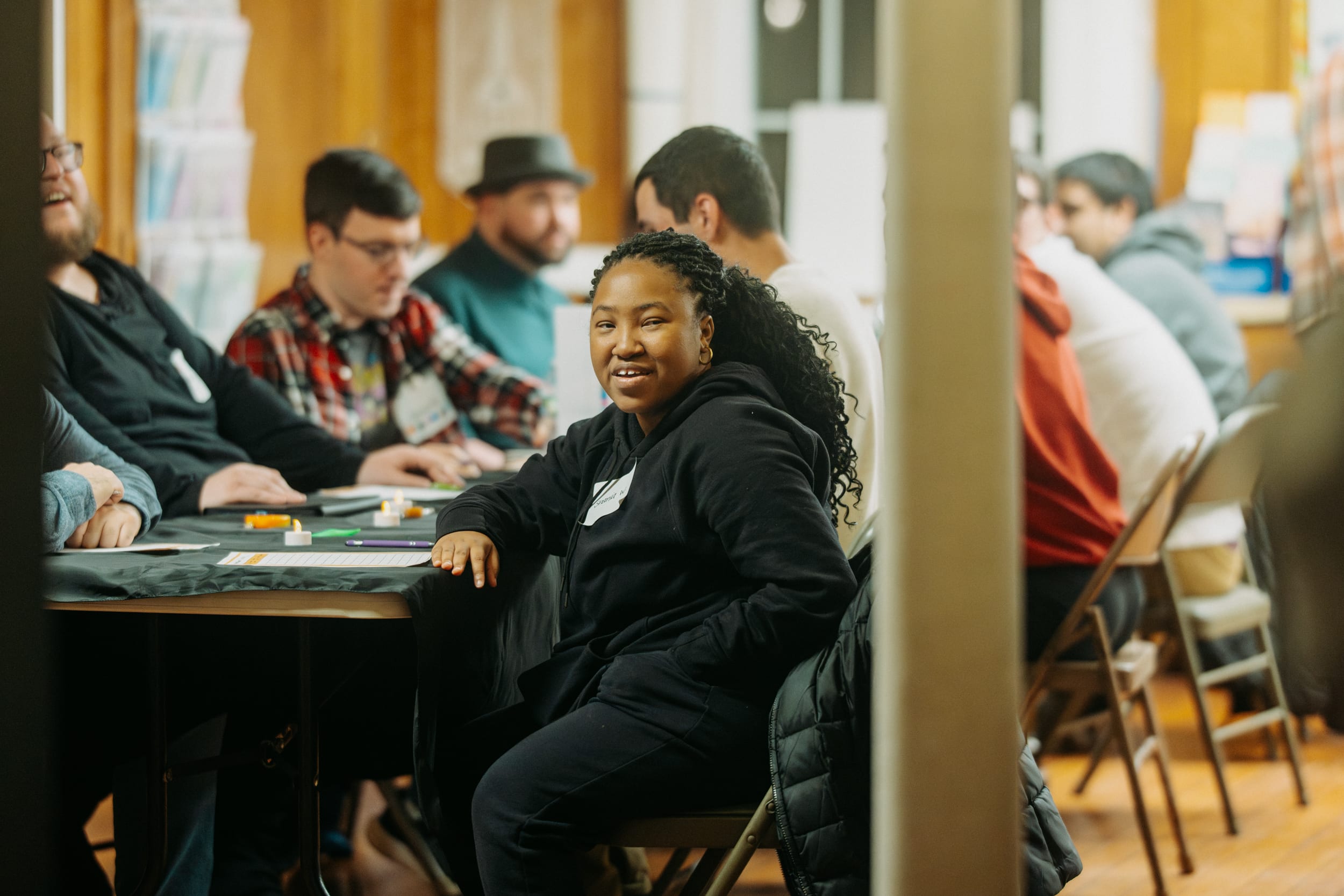
A candid, medium-shot photograph taken indoors at a social gathering or event. In the foreground, a young Black woman with long, dark, curly hair is seated at a black table, smiling and looking directly at the camera. She is wearing a black hoodie with a white sticker on her chest. She is surrounded by other people, mostly men, who are out of focus in the background, sitting at the same table. One man on the far left is laughing, and another man in the background is wearing a dark hat. The scene is warmly lit.
A black and white, candid photograph taken indoors. In the center, a man wearing a dark fedora and a dark jacket sits at a table and is looking to his left while holding a thin object near his mouth. A woman in a dark hoodie is seated across from him, seen from the back, and a third person in a plaid shirt and glasses is partially visible to the left. The table is draped with a dark cloth, with small white objects on it, suggesting a social gathering or a game.
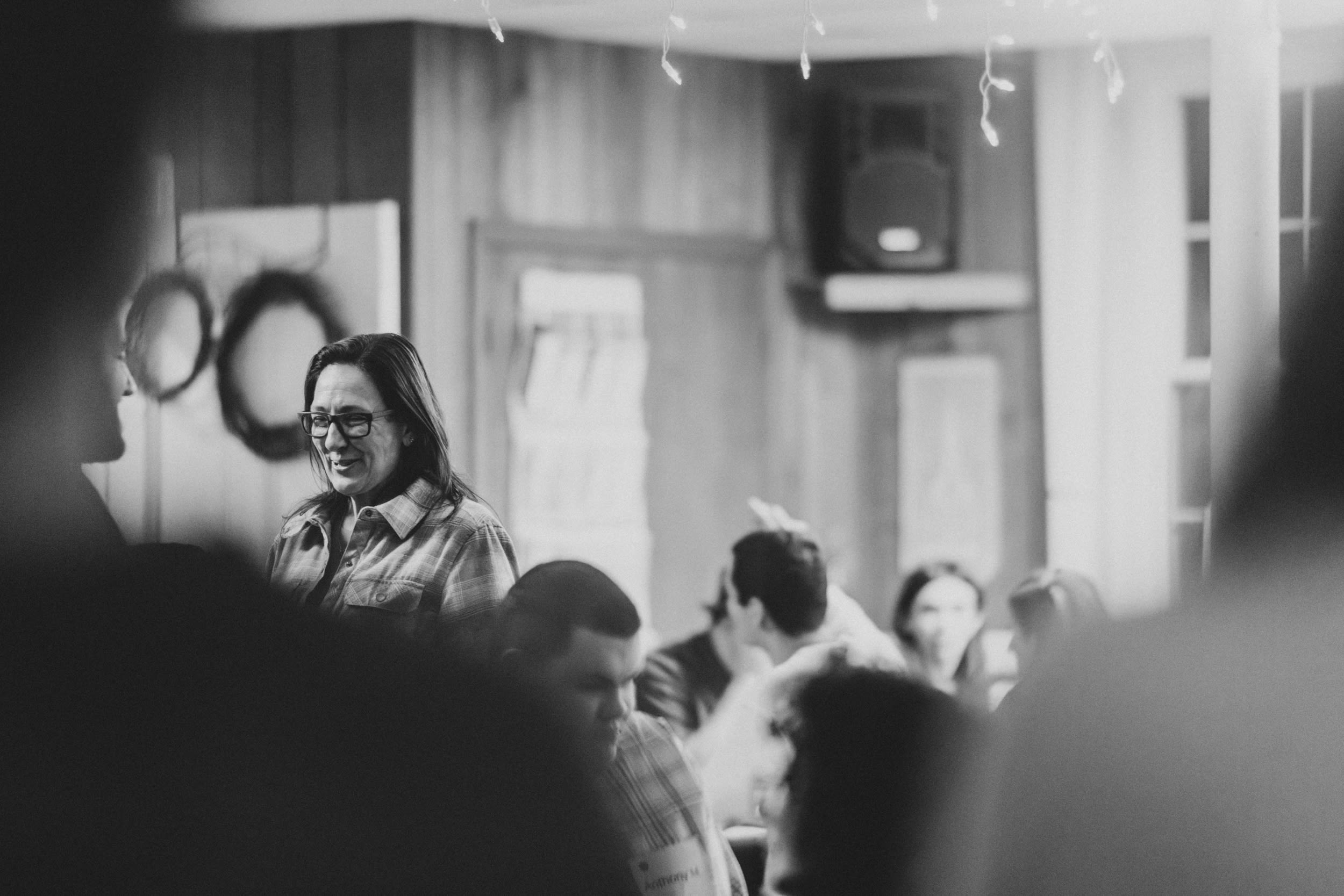
A black and white, candid photograph taken indoors at a social event. In the center-left, a woman with glasses and a plaid shirt is smiling and looking off to the right. She is surrounded by other people, with the backs of some individuals out of focus in the foreground on the left and right. The background is dimly lit, showing a wooden-paneled wall with string lights and a mounted speaker. Other guests are seated in the middle ground.
A close-up, softly-lit photograph of a white vertical sign displayed on a black table at a social event. The sign provides a legend with different colored circles next to categories, to be used with stickers. The categories are: Romance (Red), Friendship (Orange), Both (Yellow), Friendship only (Green), Music (Brown/Maroon), Sports (Purple), Movies (Dark Blue), Video Games (Teal), Food (Red/Pink), Pets/Animals (Dark Green), Anime (Brown), Exercise/Fitness (Black), and Theatre (Dark Brown/Black). Small, flickering candles and candy wrappers are visible on the table to the left and right.

A Room Designed for Real Connection

Inside the first be;yond the spectrum event and the conversations that made it come alive.

As part of our Firefly Project partnership with be;, our role that evening was to witness and document the connections forming around us. We’ve collaborated with be; for nearly two years, and one thing we’ve learned is that they build spaces with dignity at the center. This night, designed alongside Community Autism Resources and the Bridgewater State University EXCEL Program, reflected that beautifully.

When the structured conversation rounds began, the room settled into a comfortable rhythm. Rodney explained what brought him there, saying, “It brought me here tonight because I want to meet new people.” Moments later, he added, “It’s fun meeting new people.”

Dylan shared how the nerves softened once conversations started. He said, “But then when I started talking to people, it felt good.” He expanded on that thought with, “When you start talking to someone, listen to them, and then they can listen to you.”
A candid, medium-shot photograph taken indoors at a social gathering or event. In the foreground, a young Black woman with long, dark, curly hair is seated at a black table, smiling and looking directly at the camera. She is wearing a black hoodie with a white sticker on her chest. She is surrounded by other people, mostly men, who are out of focus in the background, sitting at the same table. One man on the far left is laughing, and another man in the background is wearing a dark hat. The scene is warmly lit.
A black and white, candid photograph taken indoors. In the center, a man wearing a dark fedora and a dark jacket sits at a table and is looking to his left while holding a thin object near his mouth. A woman in a dark hoodie is seated across from him, seen from the back, and a third person in a plaid shirt and glasses is partially visible to the left. The table is draped with a dark cloth, with small white objects on it, suggesting a social gathering or a game.
A black and white, candid photograph taken indoors at a social event. In the center-left, a woman with glasses and a plaid shirt is smiling and looking off to the right. She is surrounded by other people, with the backs of some individuals out of focus in the foreground on the left and right. The background is dimly lit, showing a wooden-paneled wall with string lights and a mounted speaker. Other guests are seated in the middle ground.
A close-up, softly-lit photograph of a white vertical sign displayed on a black table at a social event. The sign provides a legend with different colored circles next to categories, to be used with stickers. The categories are: Romance (Red), Friendship (Orange), Both (Yellow), Friendship only (Green), Music (Brown/Maroon), Sports (Purple), Movies (Dark Blue), Video Games (Teal), Food (Red/Pink), Pets/Animals (Dark Green), Anime (Brown), Exercise/Fitness (Black), and Theatre (Dark Brown/Black). Small, flickering candles and candy wrappers are visible on the table to the left and right.

A Room Designed for Real Connection

Inside the first be;yond the spectrum event and the conversations that made it come alive.

As part of our Firefly Project partnership with be;, our role that evening was to witness and document the connections forming around us. We’ve collaborated with be; for nearly two years, and one thing we’ve learned is that they build spaces with dignity at the center. This night, designed alongside Community Autism Resources and the Bridgewater State University EXCEL Program, reflected that beautifully.

When the structured conversation rounds began, the room settled into a comfortable rhythm. Rodney explained what brought him there, saying, “It brought me here tonight because I want to meet new people.” Moments later, he added, “It’s fun meeting new people.”

Dylan shared how the nerves softened once conversations started. He said, “But then when I started talking to people, it felt good.” He expanded on that thought with, “When you start talking to someone, listen to them, and then they can listen to you.”

A candid, medium-shot photograph taken indoors at a social gathering or event. In the foreground, a young Black woman with long, dark, curly hair is seated at a black table, smiling and looking directly at the camera. She is wearing a black hoodie with a white sticker on her chest. She is surrounded by other people, mostly men, who are out of focus in the background, sitting at the same table. One man on the far left is laughing, and another man in the background is wearing a dark hat. The scene is warmly lit.
A black and white, candid photograph taken indoors. In the center, a man wearing a dark fedora and a dark jacket sits at a table and is looking to his left while holding a thin object near his mouth. A woman in a dark hoodie is seated across from him, seen from the back, and a third person in a plaid shirt and glasses is partially visible to the left. The table is draped with a dark cloth, with small white objects on it, suggesting a social gathering or a game.
A black and white, candid photograph taken indoors at a social event. In the center-left, a woman with glasses and a plaid shirt is smiling and looking off to the right. She is surrounded by other people, with the backs of some individuals out of focus in the foreground on the left and right. The background is dimly lit, showing a wooden-paneled wall with string lights and a mounted speaker. Other guests are seated in the middle ground.
A close-up, softly-lit photograph of a white vertical sign displayed on a black table at a social event. The sign provides a legend with different colored circles next to categories, to be used with stickers. The categories are: Romance (Red), Friendship (Orange), Both (Yellow), Friendship only (Green), Music (Brown/Maroon), Sports (Purple), Movies (Dark Blue), Video Games (Teal), Food (Red/Pink), Pets/Animals (Dark Green), Anime (Brown), Exercise/Fitness (Black), and Theatre (Dark Brown/Black). Small, flickering candles and candy wrappers are visible on the table to the left and right.
A candid photograph taken at an indoor event, possibly a group meeting or social gathering. In the foreground, a young man in a blue and green plaid shirt is seated at a black-draped table, smiling, and looking toward a blonde woman in a black shirt seated across from him on the left. The man has a name tag that reads "Calke R". Small, flickering candles are visible on the table. Other people, including a man in an orange shirt, are visible, out of focus, in the background. The room has wood-paneled walls and an orange banner or accent wall in the distance.

What Young Adults Told Us

Honest reflections about nerves, excitement, and the joy of meeting new people.

Shared interests surfaced quickly. Reily told us, “I learned that a lot of the guys here like to play video games and stuff. I like to play video games as well.” That small discovery helped strangers shift toward familiarity.

The truth of the night was simple: these young adults wanted the same things anyone wants at a social gathering. They wanted people to talk to, someone who understood them, and a space where that first step didn’t feel intimidating.

The environment didn’t try to correct how they communicated. It supported their comfort and allowed them to participate in ways that felt natural.

A candid photograph taken at an indoor event, possibly a group meeting or social gathering. In the foreground, a young man in a blue and green plaid shirt is seated at a black-draped table, smiling, and looking toward a blonde woman in a black shirt seated across from him on the left. The man has a name tag that reads "Calke R". Small, flickering candles are visible on the table. Other people, including a man in an orange shirt, are visible, out of focus, in the background. The room has wood-paneled walls and an orange banner or accent wall in the distance.

What Young Adults Told Us

Honest reflections about nerves, excitement, and the joy of meeting new people.

Shared interests surfaced quickly. Reily told us, “I learned that a lot of the guys here like to play video games and stuff. I like to play video games as well.” That small discovery helped strangers shift toward familiarity.

The truth of the night was simple: these young adults wanted the same things anyone wants at a social gathering. They wanted people to talk to, someone who understood them, and a space where that first step didn’t feel intimidating.

The environment didn’t try to correct how they communicated. It supported their comfort and allowed them to participate in ways that felt natural.

A candid photograph taken at an indoor event, possibly a group meeting or social gathering. In the foreground, a young man in a blue and green plaid shirt is seated at a black-draped table, smiling, and looking toward a blonde woman in a black shirt seated across from him on the left. The man has a name tag that reads "Calke R". Small, flickering candles are visible on the table. Other people, including a man in an orange shirt, are visible, out of focus, in the background. The room has wood-paneled walls and an orange banner or accent wall in the distance.

What Young Adults Told Us

Honest reflections about nerves, excitement, and the joy of meeting new people.

Shared interests surfaced quickly. Reily told us, “I learned that a lot of the guys here like to play video games and stuff. I like to play video games as well.” That small discovery helped strangers shift toward familiarity.

The truth of the night was simple: these young adults wanted the same things anyone wants at a social gathering. They wanted people to talk to, someone who understood them, and a space where that first step didn’t feel intimidating.

The environment didn’t try to correct how they communicated. It supported their comfort and allowed them to participate in ways that felt natural.

A black and white, candid photograph taken indoors at an event. Three people are visible in the foreground. On the left, a young woman with dark hair in light-colored overalls is standing and holding a can. On the right, a woman with long, light-colored hair is smiling and looking at the third person, who is standing between them with their back mostly to the camera. The smiling woman is wearing a dark cardigan and has an ID badge on her chest. The background is a brightly lit, large indoor space with some signage.

What the Facilitators Saw

Insights from the people who helped shape the tone, structure, and success of the evening.

Throughout the night, we spoke with facilitators Mary Fox and Rosie, whose guidance helped anchor the event. Mary opened with a welcome that clarified the intention of the night:

“So welcome everybody to our first social event that we're doing this style. We have people that are looking for friends. We have people that are looking for dates. We have people that are just looking to socialize. So this is a great night to practice your conversations.”

Rosie followed with a warm reflection that captured the spirit of the room: “You get an opportunity to come out and meet some really awesome people because I can just tell that this room is filled with amazing people.”

Both perspectives aligned with what we saw through the lens: comfort grows when expectations are clear, and connection grows when environments support authenticity.

A black and white, candid photograph taken indoors at an event. Three people are visible in the foreground. On the left, a young woman with dark hair in light-colored overalls is standing and holding a can. On the right, a woman with long, light-colored hair is smiling and looking at the third person, who is standing between them with their back mostly to the camera. The smiling woman is wearing a dark cardigan and has an ID badge on her chest. The background is a brightly lit, large indoor space with some signage.

What the Facilitators Saw

Insights from the people who helped shape the tone, structure, and success of the evening.

Throughout the night, we spoke with facilitators Mary Fox and Rosie, whose guidance helped anchor the event. Mary opened with a welcome that clarified the intention of the night:

“So welcome everybody to our first social event that we're doing this style. We have people that are looking for friends. We have people that are looking for dates. We have people that are just looking to socialize. So this is a great night to practice your conversations.”

Rosie followed with a warm reflection that captured the spirit of the room: “You get an opportunity to come out and meet some really awesome people because I can just tell that this room is filled with amazing people.”

Both perspectives aligned with what we saw through the lens: comfort grows when expectations are clear, and connection grows when environments support authenticity.


A black and white, candid photograph taken indoors at an event. Three people are visible in the foreground. On the left, a young woman with dark hair in light-colored overalls is standing and holding a can. On the right, a woman with long, light-colored hair is smiling and looking at the third person, who is standing between them with their back mostly to the camera. The smiling woman is wearing a dark cardigan and has an ID badge on her chest. The background is a brightly lit, large indoor space with some signage.

What the Facilitators Saw

Insights from the people who helped shape the tone, structure, and success of the evening.

Throughout the night, we spoke with facilitators Mary Fox and Rosie, whose guidance helped anchor the event. Mary opened with a welcome that clarified the intention of the night:

“So welcome everybody to our first social event that we're doing this style. We have people that are looking for friends. We have people that are looking for dates. We have people that are just looking to socialize. So this is a great night to practice your conversations.”

Rosie followed with a warm reflection that captured the spirit of the room: “You get an opportunity to come out and meet some really awesome people because I can just tell that this room is filled with amazing people.”

Both perspectives aligned with what we saw through the lens: comfort grows when expectations are clear, and connection grows when environments support authenticity.


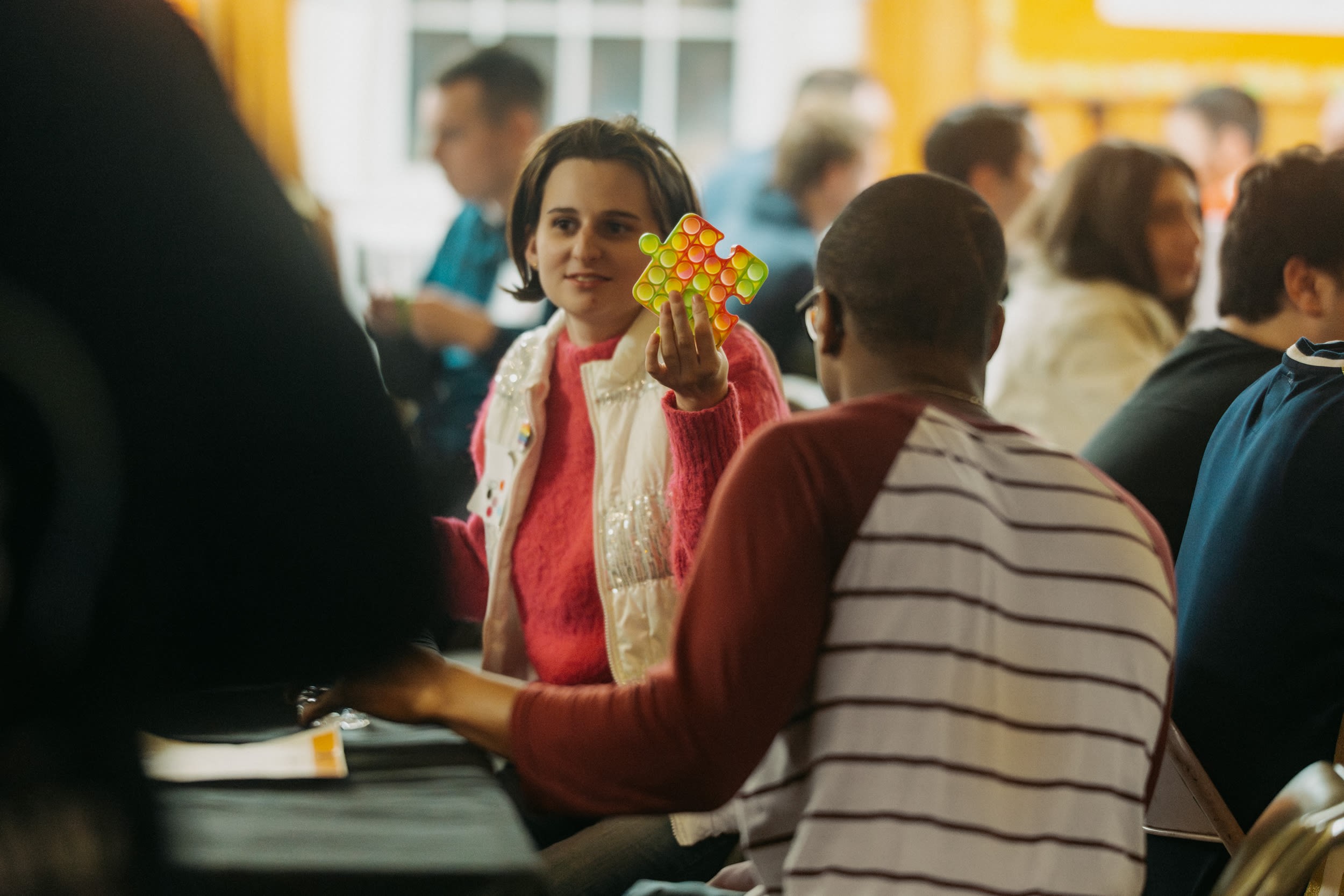
A candid photograph taken at an indoor social event, showing a woman and a man seated and talking to each other. The woman, on the left, has dark hair, is wearing a pink sweater and a white vest, and is smiling while holding up a small, colorful, hexagonal fidget toy with pop-it bubbles in red, yellow, green, orange, and pink. The man, on the right, has his back to the camera and is wearing a white shirt with red and brown patterned sleeves. Several other people are visible, out of focus, in the background, socializing in a warmly lit room with wooden accents.

Why Thoughtful Design Matters

How structure, predictability, and sensory awareness make connection more accessible.

Leading up to the event, research on socialization among young adults on the spectrum highlighted a consistent truth: they want friendships and relationships as much as anyone else. The difference lies not in desire, but in access to environments that make those connections feel comfortable.

This event used predictable, supportive design elements like conversation prompts, timed rounds, sensory tools, and clearly communicated expectations. Each choice reduced cognitive load and made space for natural interaction.

These structural decisions were not restrictive. They created room for people to show up as themselves.
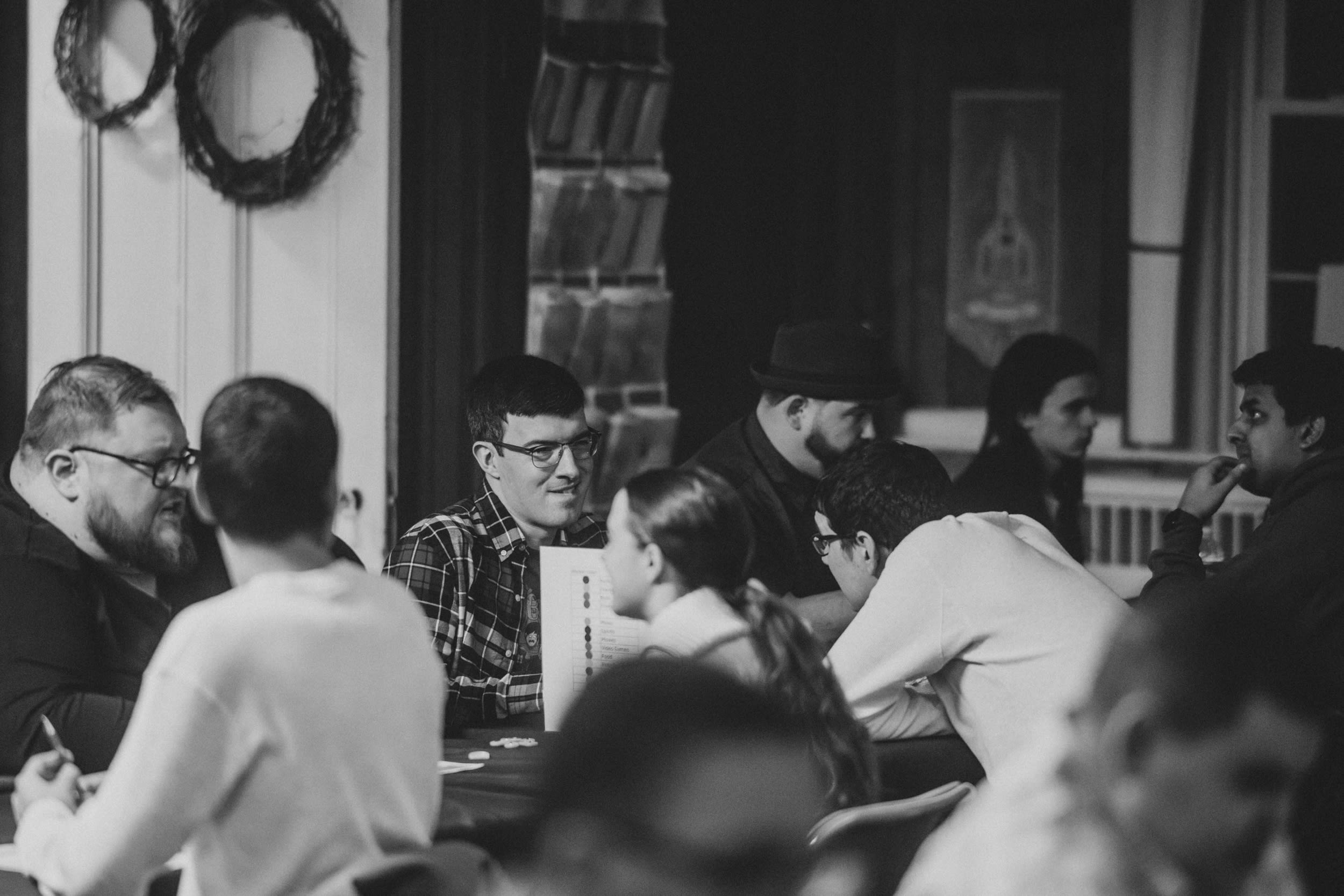
A black and white, candid photograph of a group of people seated closely around a table indoors, likely at a social gathering. In the center, a man wearing glasses and a plaid shirt is looking toward another person. He is flanked by a man with a beard on the far left and a woman with long hair on his right. Several other people, including a man in a dark fedora, are visible, seated around the table in the background. The room is dimly lit, with wreaths hanging on the back wall.
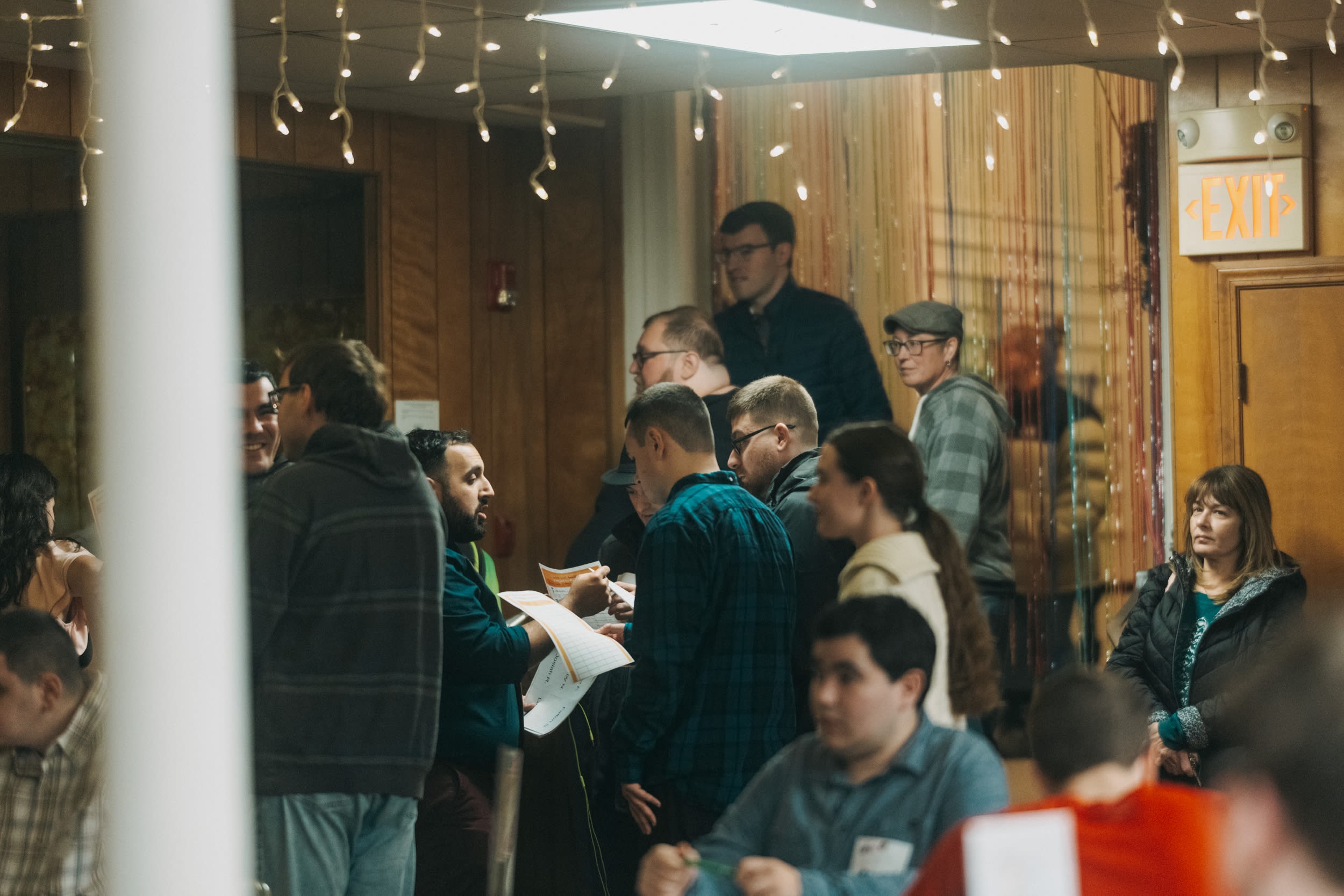
A candid, medium-shot photograph taken indoors at a crowded social event. A large group of people are standing close together, talking and socializing in a warmly lit room. String lights are draped across the ceiling in the background. On the right, an "EXIT" sign with an arrow pointing right is visible. A woman with long dark hair is standing on the far right, looking toward the camera. In the center, a man with a dark plaid shirt is holding a small piece of paper. The foreground is partially blocked by a white vertical element on the left.
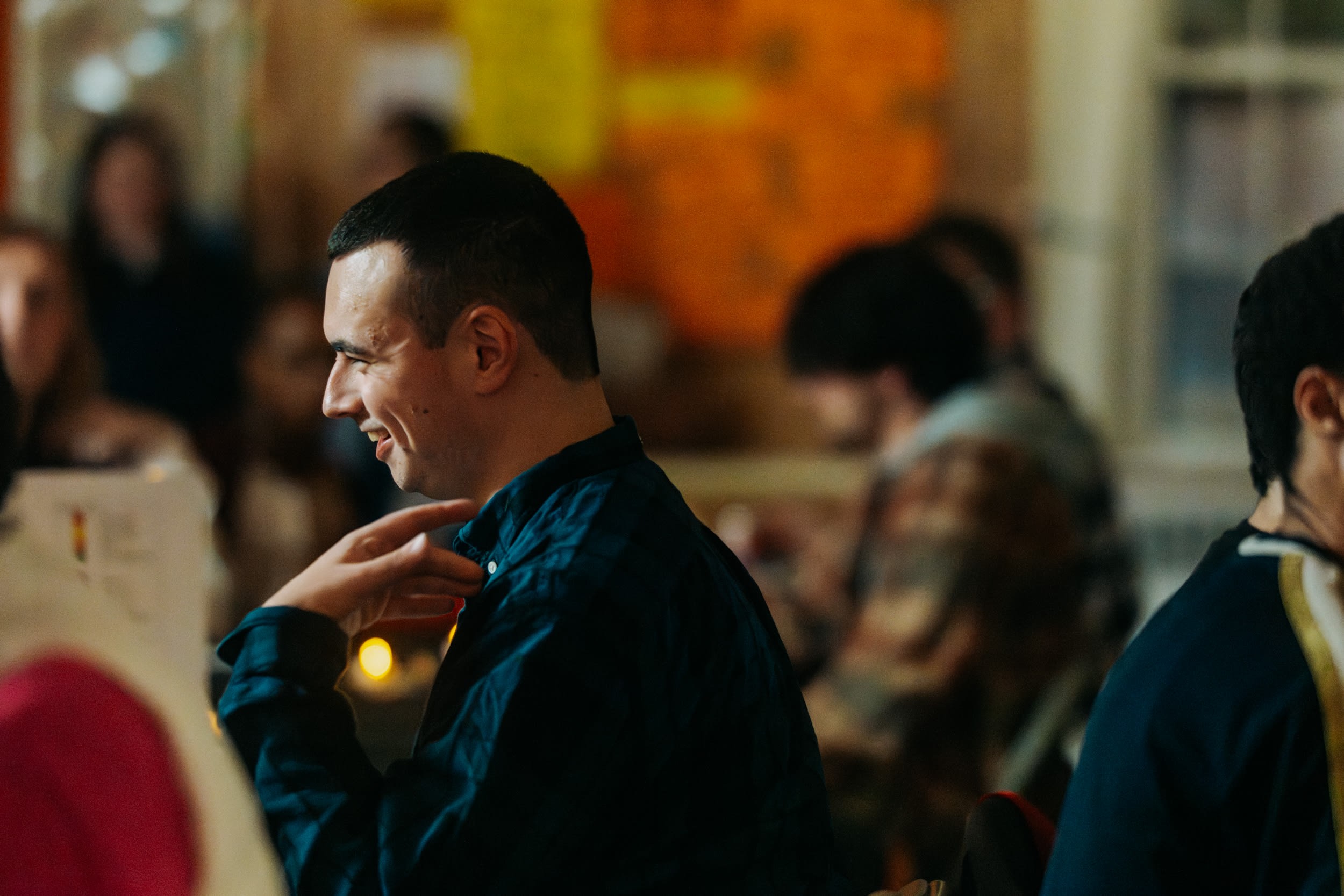
A close-up, candid, warmly-lit photograph taken indoors at a social event. A person with short, dark hair, wearing a dark blue plaid or checkered shirt, is captured in profile view, smiling and looking toward the left. Their right hand is raised near their chest, as if adjusting their collar. The background is softly blurred with warm light and shows other people seated at tables in the distance.
A candid photograph taken at an indoor social event, showing a woman and a man seated and talking to each other. The woman, on the left, has dark hair, is wearing a pink sweater and a white vest, and is smiling while holding up a small, colorful, hexagonal fidget toy with pop-it bubbles in red, yellow, green, orange, and pink. The man, on the right, has his back to the camera and is wearing a white shirt with red and brown patterned sleeves. Several other people are visible, out of focus, in the background, socializing in a warmly lit room with wooden accents.

Why Thoughtful Design Matters

How structure, predictability, and sensory awareness make connection more accessible.

Leading up to the event, research on socialization among young adults on the spectrum highlighted a consistent truth: they want friendships and relationships as much as anyone else. The difference lies not in desire, but in access to environments that make those connections feel comfortable.

This event used predictable, supportive design elements like conversation prompts, timed rounds, sensory tools, and clearly communicated expectations. Each choice reduced cognitive load and made space for natural interaction.

These structural decisions were not restrictive. They created room for people to show up as themselves.
A black and white, candid photograph of a group of people seated closely around a table indoors, likely at a social gathering. In the center, a man wearing glasses and a plaid shirt is looking toward another person. He is flanked by a man with a beard on the far left and a woman with long hair on his right. Several other people, including a man in a dark fedora, are visible, seated around the table in the background. The room is dimly lit, with wreaths hanging on the back wall.
A candid, medium-shot photograph taken indoors at a crowded social event. A large group of people are standing close together, talking and socializing in a warmly lit room. String lights are draped across the ceiling in the background. On the right, an "EXIT" sign with an arrow pointing right is visible. A woman with long dark hair is standing on the far right, looking toward the camera. In the center, a man with a dark plaid shirt is holding a small piece of paper. The foreground is partially blocked by a white vertical element on the left.
A close-up, candid, warmly-lit photograph taken indoors at a social event. A person with short, dark hair, wearing a dark blue plaid or checkered shirt, is captured in profile view, smiling and looking toward the left. Their right hand is raised near their chest, as if adjusting their collar. The background is softly blurred with warm light and shows other people seated at tables in the distance.
A candid photograph taken at an indoor social event, showing a woman and a man seated and talking to each other. The woman, on the left, has dark hair, is wearing a pink sweater and a white vest, and is smiling while holding up a small, colorful, hexagonal fidget toy with pop-it bubbles in red, yellow, green, orange, and pink. The man, on the right, has his back to the camera and is wearing a white shirt with red and brown patterned sleeves. Several other people are visible, out of focus, in the background, socializing in a warmly lit room with wooden accents.

Why Thoughtful Design Matters

How structure, predictability, and sensory awareness make connection more accessible.

Leading up to the event, research on socialization among young adults on the spectrum highlighted a consistent truth: they want friendships and relationships as much as anyone else. The difference lies not in desire, but in access to environments that make those connections feel comfortable.

This event used predictable, supportive design elements like conversation prompts, timed rounds, sensory tools, and clearly communicated expectations. Each choice reduced cognitive load and made space for natural interaction.

These structural decisions were not restrictive. They created room for people to show up as themselves.

A black and white, candid photograph of a group of people seated closely around a table indoors, likely at a social gathering. In the center, a man wearing glasses and a plaid shirt is looking toward another person. He is flanked by a man with a beard on the far left and a woman with long hair on his right. Several other people, including a man in a dark fedora, are visible, seated around the table in the background. The room is dimly lit, with wreaths hanging on the back wall.
A candid, medium-shot photograph taken indoors at a crowded social event. A large group of people are standing close together, talking and socializing in a warmly lit room. String lights are draped across the ceiling in the background. On the right, an "EXIT" sign with an arrow pointing right is visible. A woman with long dark hair is standing on the far right, looking toward the camera. In the center, a man with a dark plaid shirt is holding a small piece of paper. The foreground is partially blocked by a white vertical element on the left.
A close-up, candid, warmly-lit photograph taken indoors at a social event. A person with short, dark hair, wearing a dark blue plaid or checkered shirt, is captured in profile view, smiling and looking toward the left. Their right hand is raised near their chest, as if adjusting their collar. The background is softly blurred with warm light and shows other people seated at tables in the distance.

Understanding the Diagnosis Gaps

A closer look at why girls and AFAB individuals are often missed or misdiagnosed.

One learning that stood out during our preparation was the under-diagnosis of autistic girls and AFAB (assigned female at birth) individuals. Diagnostic criteria have historically reflected male presentations of autism, leading to generations of girls and AFAB people who masked deeply, were misdiagnosed, or were never diagnosed at all.

Seeing the gender skew at the event made this disparity visible. It wasn’t a reflection of who belongs in spaces like this; it was a reminder of who has been underserved by diagnostic systems and how community events can help repair that gap.
Understanding the Diagnosis Gaps

A closer look at why girls and AFAB individuals are often missed or misdiagnosed.

One learning that stood out during our preparation was the under-diagnosis of autistic girls and AFAB (assigned female at birth) individuals. Diagnostic criteria have historically reflected male presentations of autism, leading to generations of girls and AFAB people who masked deeply, were misdiagnosed, or were never diagnosed at all.

Seeing the gender skew at the event made this disparity visible. It wasn’t a reflection of who belongs in spaces like this; it was a reminder of who has been underserved by diagnostic systems and how community events can help repair that gap.

Understanding the Diagnosis Gaps

A closer look at why girls and AFAB individuals are often missed or misdiagnosed.

One learning that stood out during our preparation was the under-diagnosis of autistic girls and AFAB (assigned female at birth) individuals. Diagnostic criteria have historically reflected male presentations of autism, leading to generations of girls and AFAB people who masked deeply, were misdiagnosed, or were never diagnosed at all.

Seeing the gender skew at the event made this disparity visible. It wasn’t a reflection of who belongs in spaces like this; it was a reminder of who has been underserved by diagnostic systems and how community events can help repair that gap.

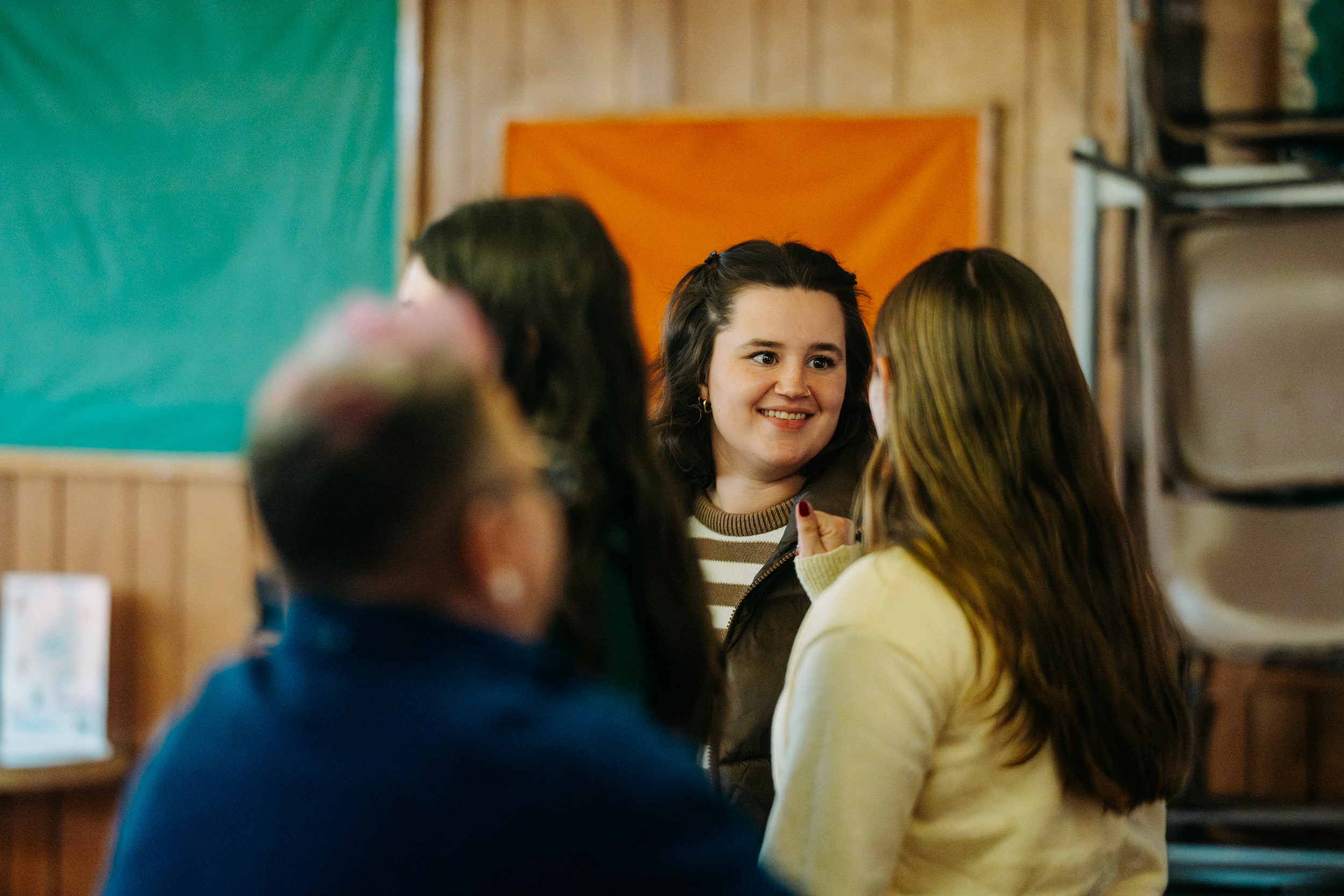
A candid photograph taken indoors, showing a young woman in the center with dark, curly hair, a striped sweater, and a dark vest. She is smiling and looking toward a person on the right. The background is a wooden wall decorated with large blocks of color, including teal and orange fabric, and some stacked chairs on the far right. The back of a person in a blue shirt is visible and blurred in the foreground on the left.

Community Autism Resources (CAR)

A partner deeply rooted in empowerment, dignity, and lifelong community support.

Community Autism Resources has been supporting the autism spectrum community across Southeastern Massachusetts for decades. Their programs, trainings, family supports, and sensory-friendly events reflect a philosophy centered on empowerment and inclusion.

At the event, CAR staff moved through the room naturally. They encouraged conversations, supported attendees when needed, and allowed space when that was the most respectful choice. Their presence wasn’t directive; it was grounding.

This partnership strengthened the event and created a foundation for future programming.

A candid photograph taken indoors, showing a young woman in the center with dark, curly hair, a striped sweater, and a dark vest. She is smiling and looking toward a person on the right. The background is a wooden wall decorated with large blocks of color, including teal and orange fabric, and some stacked chairs on the far right. The back of a person in a blue shirt is visible and blurred in the foreground on the left.

Community Autism Resources (CAR)

A partner deeply rooted in empowerment, dignity, and lifelong community support.

Community Autism Resources has been supporting the autism spectrum community across Southeastern Massachusetts for decades. Their programs, trainings, family supports, and sensory-friendly events reflect a philosophy centered on empowerment and inclusion.

At the event, CAR staff moved through the room naturally. They encouraged conversations, supported attendees when needed, and allowed space when that was the most respectful choice. Their presence wasn’t directive; it was grounding.

This partnership strengthened the event and created a foundation for future programming.

A candid photograph taken indoors, showing a young woman in the center with dark, curly hair, a striped sweater, and a dark vest. She is smiling and looking toward a person on the right. The background is a wooden wall decorated with large blocks of color, including teal and orange fabric, and some stacked chairs on the far right. The back of a person in a blue shirt is visible and blurred in the foreground on the left.

Community Autism Resources (CAR)

A partner deeply rooted in empowerment, dignity, and lifelong community support.

Community Autism Resources has been supporting the autism spectrum community across Southeastern Massachusetts for decades. Their programs, trainings, family supports, and sensory-friendly events reflect a philosophy centered on empowerment and inclusion.

At the event, CAR staff moved through the room naturally. They encouraged conversations, supported attendees when needed, and allowed space when that was the most respectful choice. Their presence wasn’t directive; it was grounding.

This partnership strengthened the event and created a foundation for future programming.

A candid, medium-shot photograph taken indoors at a social event. A young man with dark, curly hair and a beard is seated at a black table, smiling and looking off to his right. He is wearing a dark, short-sleeved jersey with a yellow name tag that reads "Kadney" on his chest. A red and white soda can and a white paper are on the table in front of him. The background is softly lit and blurred, showing other attendees seated at tables. A person is partially visible in the out-of-focus foreground on the far left.

BSU’s EXCEL Program

Higher education and community belonging through inclusive design.

The EXCEL Program at Bridgewater State University offers a four-year inclusive college experience for students with intellectual and developmental disabilities. Students participate in academic coursework, campus activities, independent-living skill building, and career exploration.

EXCEL’s involvement in shaping this event was invaluable. Their experience supporting young adults on the spectrum informed everything from the structure to the tone. Watching EXCEL students engage confidently throughout the night reinforced how powerful inclusive education can be when people are given access to the environments and expectations they deserve.

A candid, medium-shot photograph taken indoors at a social event. A young man with dark, curly hair and a beard is seated at a black table, smiling and looking off to his right. He is wearing a dark, short-sleeved jersey with a yellow name tag that reads "Kadney" on his chest. A red and white soda can and a white paper are on the table in front of him. The background is softly lit and blurred, showing other attendees seated at tables. A person is partially visible in the out-of-focus foreground on the far left.

BSU’s EXCEL Program

Higher education and community belonging through inclusive design.

The EXCEL Program at Bridgewater State University offers a four-year inclusive college experience for students with intellectual and developmental disabilities. Students participate in academic coursework, campus activities, independent-living skill building, and career exploration.

EXCEL’s involvement in shaping this event was invaluable. Their experience supporting young adults on the spectrum informed everything from the structure to the tone. Watching EXCEL students engage confidently throughout the night reinforced how powerful inclusive education can be when people are given access to the environments and expectations they deserve.

A candid, medium-shot photograph taken indoors at a social event. A young man with dark, curly hair and a beard is seated at a black table, smiling and looking off to his right. He is wearing a dark, short-sleeved jersey with a yellow name tag that reads "Kadney" on his chest. A red and white soda can and a white paper are on the table in front of him. The background is softly lit and blurred, showing other attendees seated at tables. A person is partially visible in the out-of-focus foreground on the far left.

BSU’s EXCEL Program

Higher education and community belonging through inclusive design.

The EXCEL Program at Bridgewater State University offers a four-year inclusive college experience for students with intellectual and developmental disabilities. Students participate in academic coursework, campus activities, independent-living skill building, and career exploration.

EXCEL’s involvement in shaping this event was invaluable. Their experience supporting young adults on the spectrum informed everything from the structure to the tone. Watching EXCEL students engage confidently throughout the night reinforced how powerful inclusive education can be when people are given access to the environments and expectations they deserve.

A black and white, candid photograph taken indoors, likely at a social gathering. In the background on the left, a Christmas tree is brightly lit with string lights. In the center, two women are engaged in conversation. The woman on the left has long dark hair and is wearing a dark top, facing the woman on the right. The woman on the right has shoulder-length hair, is wearing a light-colored top, and is holding a drink. Other people are visible and out of focus in the background, and the blurred back of a person is in the immediate foreground.

What Stays With You

The reflections that carried the most meaning.

Some of the most memorable reflections came from the young adults themselves. Eli shared, “Don’t stop believing. Always try and never lose your mindset. Focus on the goal and aim for the target so you can shoot your shot.”

Dylan offered reassurance for anyone hesitant about attending in the future. He said, “I would just say give it a try. Like, don’t think too far ahead. Just like stop and just like wait a few minutes. Take a couple breaths.”

These words carried sincerity and confidence, and they captured exactly what this night accomplished: connection grounded in dignity and possibility.

A black and white, candid photograph taken indoors, likely at a social gathering. In the background on the left, a Christmas tree is brightly lit with string lights. In the center, two women are engaged in conversation. The woman on the left has long dark hair and is wearing a dark top, facing the woman on the right. The woman on the right has shoulder-length hair, is wearing a light-colored top, and is holding a drink. Other people are visible and out of focus in the background, and the blurred back of a person is in the immediate foreground.

What Stays With You

The reflections that carried the most meaning.

Some of the most memorable reflections came from the young adults themselves. Eli shared, “Don’t stop believing. Always try and never lose your mindset. Focus on the goal and aim for the target so you can shoot your shot.”

Dylan offered reassurance for anyone hesitant about attending in the future. He said, “I would just say give it a try. Like, don’t think too far ahead. Just like stop and just like wait a few minutes. Take a couple breaths.”

These words carried sincerity and confidence, and they captured exactly what this night accomplished: connection grounded in dignity and possibility.

A black and white, candid photograph taken indoors, likely at a social gathering. In the background on the left, a Christmas tree is brightly lit with string lights. In the center, two women are engaged in conversation. The woman on the left has long dark hair and is wearing a dark top, facing the woman on the right. The woman on the right has shoulder-length hair, is wearing a light-colored top, and is holding a drink. Other people are visible and out of focus in the background, and the blurred back of a person is in the immediate foreground.

What Stays With You

The reflections that carried the most meaning.

Some of the most memorable reflections came from the young adults themselves. Eli shared, “Don’t stop believing. Always try and never lose your mindset. Focus on the goal and aim for the target so you can shoot your shot.”

Dylan offered reassurance for anyone hesitant about attending in the future. He said, “I would just say give it a try. Like, don’t think too far ahead. Just like stop and just like wait a few minutes. Take a couple breaths.”

These words carried sincerity and confidence, and they captured exactly what this night accomplished: connection grounded in dignity and possibility.

A warmly lit, candid photograph of a large, diverse group of people posing for a photo indoors on a staircase landing. The group is casually dressed and includes men and women, many of whom are smiling and making a peace sign gesture. A person in the front center is wearing a black t-shirt with a colorful "Community Builder" logo. The background features a large, arched window above the group, and a wooden staircase is visible on the right.

Where the Story Goes Next

A look toward future events and the community growing around them.

By the end of the evening, the room felt unmistakably connected. People lingered in conversations, exchanged contact information, and reflected openly on the experience. It was clear that this event had carved out something meaningful for young adults on the spectrum and their families.

Future connection nights are already in discussion, and interest is growing. For anyone who wants to be part of what comes next, be; has created an interest list for upcoming events. It’s the best way to stay informed about dates, registration, and new programs evolving from this foundation.

A warmly lit, candid photograph of a large, diverse group of people posing for a photo indoors on a staircase landing. The group is casually dressed and includes men and women, many of whom are smiling and making a peace sign gesture. A person in the front center is wearing a black t-shirt with a colorful "Community Builder" logo. The background features a large, arched window above the group, and a wooden staircase is visible on the right.

Where the Story Goes Next

A look toward future events and the community growing around them.

By the end of the evening, the room felt unmistakably connected. People lingered in conversations, exchanged contact information, and reflected openly on the experience. It was clear that this event had carved out something meaningful for young adults on the spectrum and their families.

Future connection nights are already in discussion, and interest is growing. For anyone who wants to be part of what comes next, be; has created an interest list for upcoming events. It’s the best way to stay informed about dates, registration, and new programs evolving from this foundation.

A warmly lit, candid photograph of a large, diverse group of people posing for a photo indoors on a staircase landing. The group is casually dressed and includes men and women, many of whom are smiling and making a peace sign gesture. A person in the front center is wearing a black t-shirt with a colorful "Community Builder" logo. The background features a large, arched window above the group, and a wooden staircase is visible on the right.

Where the Story Goes Next

A look toward future events and the community growing around them.

By the end of the evening, the room felt unmistakably connected. People lingered in conversations, exchanged contact information, and reflected openly on the experience. It was clear that this event had carved out something meaningful for young adults on the spectrum and their families.

Future connection nights are already in discussion, and interest is growing. For anyone who wants to be part of what comes next, be; has created an interest list for upcoming events. It’s the best way to stay informed about dates, registration, and new programs evolving from this foundation.